
The Zen of JigSaw Puzzles - A How-To
Practicing the Art of Letting Go
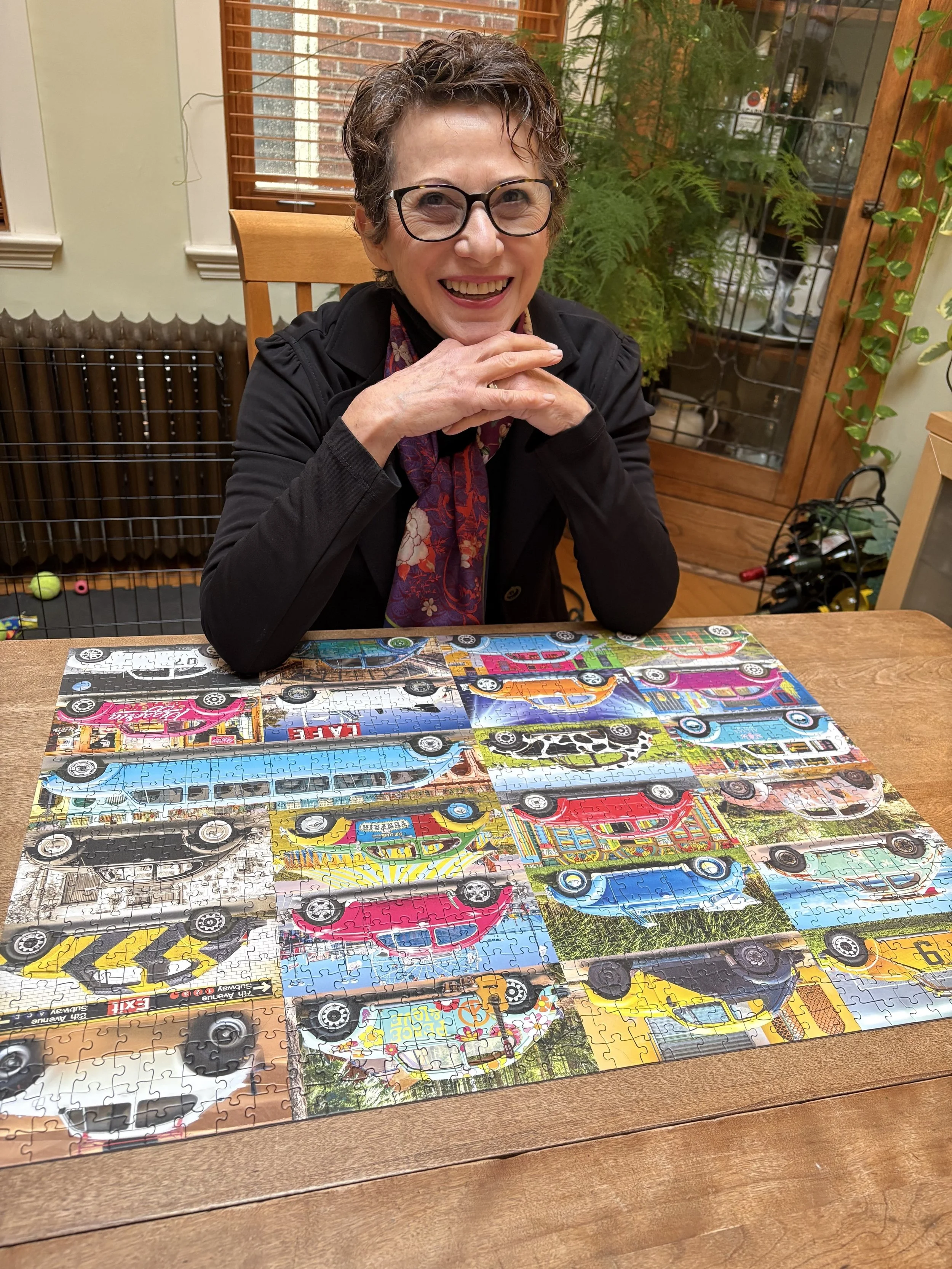
It’s cold and dark here in the northeast right now, dead of winter, and snow is filtering the light as it blankets the skylight in my dining room. Perfect time to start a jigsaw puzzle!
In Runaway Husbands, I wrote about how I did jigsaw puzzles in the early weeks to help me get through the evening. Instead of obsessing about my husband, I spent the time concentrating, looking for the little man with the blue hat. Doing jigsaw puzzles helped me - I hope they will help you, too! Here’s my suggestion about how to enjoy putting together a puzzle.
I like to choose a puzzle that is made up of many different squares on the same theme. Once I did a puzzle of handbags. Today, it’s 24 different pictures of Volkswagen beetles, all different colors, some old, some new and even a VW bug limousine!
First you have to locate the best big table to use - I use my dining room table. And then, I add a lamp - lighting is important! And then, it’s the moment that you open the box, cut open the bag holding all the pieces and it’s time! You’re committed.
The starting stage is tedious - turning all the pieces over - but in the process, I separate out all the edge pieces.
The next part I like - creating the frame by linking all the edges. Then we get an idea of the size and figure out how it will fit on the table. You sort of have to fill the frame with all the loose pieces - there’s usually no other place to put them!
Then I separate the loose pieces into groups. All pieces that have red in them, that have grass, that have sky, that are black. This takes time but it’s worth it in the end.
Doing a jigsaw puzzle is an activity that uses both your right brain and your left brain. You’re using your spacial sense when you start to remember the location in the pile of specific pieces by their color and shape. Your left brain comes in when you engage in creating order out of chaos. Putting the pieces of your life back together?
There’s an emotional element to completing a jigsaw puzzle. I find it very relaxing and can even enjoy the early stages when not much is happening because I’m looking forward to the later stages. Every successful discovery of the right place for the piece releases a tiny burst of dopamine and it feels good. You have to have good frustration tolerance and can keep your anxiety at bay.
In the middle stage, the picture starts to take shape. You have little pockets of areas that you were able to complete and you stroke their surface - it feels nice. You may have a problem taking a break and find yourself sitting there, hunched over, long after you really should be in bed.
Listening to music and drinking a hot chocolate with little marshmallows helps.
I find that in the later stages, my brain is doing something different. I’ll see a piece and not really knowing how I know where it goes, my hand guides it just to the right spot. It’s like some sub-conscous force is at play. I even get surprised that I managed that!
In these later stages, I have a choice as to how to find the piece to put in a spot. Do I look at the puzzle and try to locate the piece that’s missing or pick up a piece and then try to find where it goes in the puzzle. Both methods work.
And in the final stages, when there are fewer pieces left to place and there are spots where one piece is missing from the field, I sometimes search for the piece by shape rather than by color. For example, a piece may look like a square with an innie on each side, or it may be a mix, with three innies and an outie.
And then ten . . . nine . . . eight . . . and it’s done. And you feel good.
Doing a jigsaw puzzle takes a long time. It takes you away from your troubles. It offers tiny bits of frustration and then those tiny bursts of satisfaction. It engages your mind. It’s quiet, peaceful and doesn’t require electricity or batteries. It’s a great thing to do with others. It requires concentration. It slows you down. You can then give the puzzle to someone else and it will nourish that person too. It’s temporary and teaches you to work hard to create something and then break it down and that’s a good skill to practice - to let it go. It’s like making music in that way. The magic is in the doing.